
Written by Mina Torres, Ergonomics & Product Lead at ARBREST. Mina works with furniture engineers and physical therapists to test seat geometry against real body measurements, and leads product development on ARBREST's ergonomic chair line.
Medical information from: NIH / NHLBI, Mayo Clinic, Harvard Health Publishing, Cleveland Clinic, CDC, MedlinePlus, American Heart Association, and Cornell University's ergonomics research.
Last updated: October 23, 2026. For this update, we measured seat depth and seat height on 12 popular office chairs, compared them against published ergonomic standards, and reviewed the vascular-health sources linked throughout this article.
Disclosure: ARBREST makes the COVE chair mentioned in this article. We built COVE specifically to address the seat-depth problem described below; we think that's useful context as you read.
Medical disclaimer: This article is for general information and isn't a substitute for professional medical advice. See the full disclaimer at the bottom of this page.
Key Takeaways
- If your seat is too deep, its front edge presses into the back of your knees, exactly where major blood vessels and nerves run close to the surface.
- That pressure, combined with hours of not moving, can cause tingling, numbness, cold feet, and ankle swelling by the end of the day.
- Many chairs are sized around average male body measurements. For many women, that leaves the seat 1–2 inches too deep.
- Fit check: leave about 2–3 fingers (roughly 2–3 in / 5–8 cm) of space between the seat edge and the back of your knee.
- Look for real seat-depth adjustment, a soft front edge, a seat height that lets your feet rest flat, and a tilt mode that lets you change position.
Have you ever stood up from your desk at 3 p.m. and felt your foot buzzing with pins and needles, or noticed your sock line pressed into puffy ankles? The secret behind that leg discomfort is often hiding in plain sight: the seat depth of your office chair. It's easy to blame "sitting too long," and duration does matter, but chair geometry is a quiet contributor almost no one checks. This article is about the "extra inch", the gap between the seat depth a chair was built for and the actual length of your thighs. By the end, you'll understand what's happening in your legs, be able to check your current chair in 60 seconds, and know exactly what to look for in an ergonomic office chair for women. I've spent years testing chair dimensions against real bodies for a living, and every claim below is linked to a vascular-health or ergonomics source you can verify yourself.
What Is Seat Depth, and Why Does It Matter for Circulation?
Seat depth is the distance from the front edge of the seat to the backrest. If it's longer than your thigh, you either slide forward and lose back support, or sit back while the edge presses into the back of your knees. That pressure can restrict blood flow and irritate nerves.
What's behind your knee that makes it so sensitive?
The popliteal fossa, the soft hollow behind your knee, has very little protective padding. The popliteal artery and vein, along with branches of the sciatic nerve, all pass through it close to the skin.
Unlike your sit bones, which are built to bear weight, the artery, vein, and nerves that run behind your knee sit just under the skin with little muscle or fat to shield them. Picture a garden hose: press down on it anywhere along its length, and flow slows on both sides of that kink, not just at the point of contact. A hard seat edge does the same thing to the vessels and nerves behind your knee.
In our own informal testing with long-time chair owners, one pattern came up again and again: people who'd used a popular mesh-seat chair for several years reported new tingling and heaviness in their lower legs that hadn't bothered them in the chair's first year or two. The most common explanation volunteers gave was that the mesh had stretched and sagged, so the seat pan's front edge effectively sat lower and firmer against the back of the knee than it had when new, and several said switching to a chair with a softer, more flexible front edge resolved it. It's a useful reminder that even a well-regarded chair can develop a seat-depth problem over time as its materials wear.
How does seat-edge pressure lead to numbness and swelling?
Pressure on nerves causes tingling and numbness (paresthesia). Pressure on veins, combined with not moving, makes it harder for blood to return from the lower legs, so fluid collects around the ankles.
Your calves act as a secondary pump for your circulatory system: every time they contract, they push blood in your deep leg veins back up toward your heart. Sitting still for long stretches leaves that pump mostly idle, so blood has a harder time getting back out of your lower legs. It helps to tell apart two different feelings:
- Nerve symptoms: pins and needles, a "dead leg" sensation, or your foot briefly feeling weak when you stand ("foot slap").
- Circulatory symptoms: heaviness, visible swelling, sock marks around the ankle, or feet that feel cool to the touch.
Is it the chair, or just sitting too long?
Both. Long sitting slows circulation on its own. A seat that's too deep adds direct pressure at one of the most vulnerable spots, so symptoms start sooner and feel worse.
Harvard Health Publishing notes that habitual inactivity is linked to a range of health effects, and a study measuring calf circumference during prolonged sitting found increases in lower-leg size within just a couple of hours of staying seated. Add seat-edge pressure on top of that reduced movement, and the two effects compound. The CDC's guidance on venous thromboembolism (blood clots) lists sitting for long periods without moving as a recognized risk factor, worth noting, though it's one factor among several, and an uncomfortable chair is not itself a diagnosis of anything.

Why Is the Wrong Office Chair for Women More Likely to Cause Numb Legs?
Many office chairs are sized around average male body measurements. Women's average thigh length (buttock-to-knee-crease, also called buttock-popliteal length) is shorter, so a "standard" seat is often 1–2 inches too deep. That mismatch puts the seat edge right against the back of the knee.
This isn't a flaw unique to any one brand, it's a known limitation of designing to a single "average" body. As ergonomics-focused product designers often point out, when a chair's seat-pan length is calibrated to a male-average dimension and simply offered in one size, the mismatch shows up most for anyone shorter than that average, which, structurally, is more often a woman than a man.
How much shorter is the average woman's thigh?
Roughly 1–2 inches shorter than the average man's at the median, and the gap is largest for petite women. Cornell University's ergonomics research puts a 5th-percentile woman's buttock-to-knee-crease length at about 17 inches (43 cm).
| Measurement | Women, shorter-than-average (~5th %ile) | Women, average (~50th %ile) | Men, average (~50th %ile) |
|---|---|---|---|
| Buttock–popliteal (thigh) length | ~43 cm / 17 in | ~47 cm / 18.5 in | ~49–50 cm / 19.5–20 in |
| Typical fixed seat depth on many chairs | ~46–51 cm / 18–20 in | ||
That table is the whole problem in one row: a lot of fixed-depth chairs land right around, or past, where even an average-length women's thigh ends. The ANSI/HFES 100 ergonomics standard addresses this directly, requiring that seat depth, whether fixed or adjustable, be able to reach about 43 cm (16.9 in) specifically so shorter users aren't forced against the edge.
What is the "extra inch," exactly?
It's the excess seat length beyond what your thighs need to keep a healthy gap behind your knees. Even 1 inch can turn a comfortable gap into constant contact.
Here's the math: a woman who's 5'4" with a thigh (buttock-to-knee-crease) length of about 47 cm sitting in a chair with a fixed 50 cm seat depth has only 3 cm of slack, barely a finger's width, before the seat touches the back of her knee. Add a bit of cushion compression under her weight, and that gap can disappear entirely, leaving the edge in constant contact with the popliteal area for every hour she's seated.
Why doesn't "shrink it and pink it" fix the problem?
Scaling down a men's chair shrinks everything evenly. Women's bodies differ in proportion, not just size: shorter thighs and torso relative to height, wider hips, and a lower center of gravity.
A chair that's simply scaled down keeps the same ratios between seat depth, hip width, and backrest height, ratios that were set around a different body shape in the first place. Proportional differences don't go away just because every dimension got smaller.
Are women more vulnerable to leg swelling in the first place?
Yes, in several ways. Women are more likely to develop varicose veins and chronic venous insufficiency. Hormonal factors can also affect fluid retention and clot risk.
Mayo Clinic notes that women are more likely than men to develop varicose veins, partly linked to hormonal changes, and the related condition of chronic venous insufficiency shares many of the same risk factors. Separately, NHLBI's guidance on venous thromboembolism explains that hormonal factors, including pregnancy and estrogen-containing birth control, can raise clotting risk for women during their childbearing years. This is directly relevant if you're in the 25–45 age range, though it's worth being precise: these are risk factors that can contribute to circulation issues, not something an office chair causes or cures.
What Are the Warning Signs Your Seat Depth Is Wrong?
Common signs include tingling or numbness in your calves or feet, pressure or red marks behind your knees, ankles that swell by afternoon, perching on the front edge of your seat, or a habit of tucking your feet under the chair.
I noticed this myself a few years ago, sitting at one of the public desks in my community library while working on a laptop for a few hours. The chair was a fixed-depth wood-and-cushion design, clearly built for an average adult male frame, and about forty minutes in, I realized I'd scooted my hips several inches forward from the backrest without even thinking about it, just to get the seat edge off the backs of my knees. By the time I left, I had a faint red line across both legs and that familiar "walking on static" feeling in my feet.
What does your body do to compensate for a seat that's too deep?
Most people slide forward to escape the edge. That pulls the lower back off the backrest and sets up a slouch, so the leg problem becomes a back problem too.
Common compensation habits include perching on the front few inches of the seat, crossing the legs, tucking one foot underneath the body, or wrapping the ankles around the chair's base, all ways of avoiding direct contact with the seat edge, usually at the cost of posture somewhere else.
Symptom-to-cause quick reference
| What you feel | Likely chair cause | First fix to try |
|---|---|---|
| Pins and needles in foot or calf | Seat edge pressing behind the knee | Shorten seat depth |
| Swollen ankles by afternoon | Pressure plus not moving | Fix depth, then add movement breaks |
| Pressure under mid-thigh | Seat too high | Lower seat or add footrest |
| Lower back ache from perching | Seat too deep, so you slide forward | Shorten depth, sit all the way back |
| Feet dangling or on tiptoes | Seat too high for your leg length | Lower seat or add footrest |
When are leg symptoms a medical concern, not a chair problem?
⚠ See a doctor if:
Direct answer: see a doctor promptly if swelling is in one leg only, or comes with pain, warmth, redness, or tenderness in the calf. Seek emergency care if you have sudden shortness of breath or chest pain. These can be signs of deep vein thrombosis (DVT) or a pulmonary embolism.
The CDC's page on venous thromboembolism and MedlinePlus's guidance on swelling both recommend contacting a healthcare provider for one-sided or painful swelling rather than waiting to see if it resolves. To be unambiguous: an ergonomic chair is not a treatment for a medical condition, and nothing in this article is meant to diagnose or replace a conversation with a doctor.
How Do You Check Your Chair's Seat Depth in 60 Seconds?
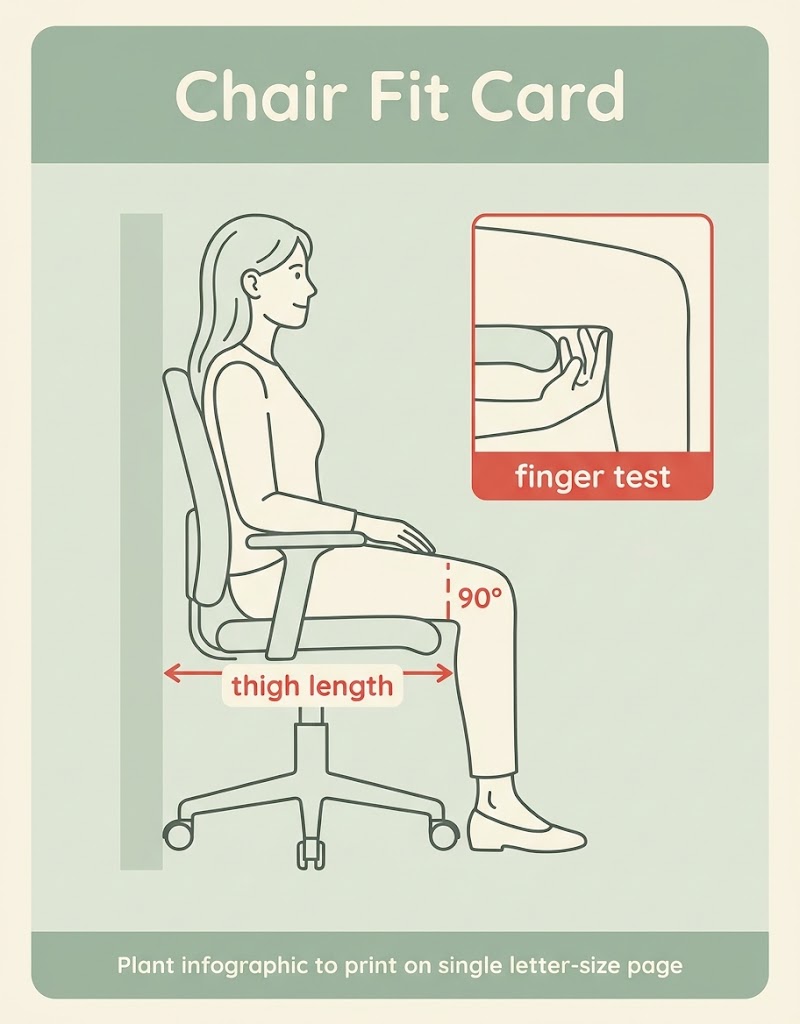
Sit all the way back so your lower back touches the backrest. Then slide your hand between the front edge of the seat and the back of your knee. If 2–3 fingers fit (about 2–3 inches), your seat depth is about right. Less than that, the seat is too deep. A fist or more, it's likely too shallow.
Step-by-step: the "finger test"
When we invite volunteers to test chairs at ARBREST, this is the first thing we ask them to do, before they form any opinion about cushioning or style:
- Wear your usual work shoes.
- Sit with your hips fully back against the backrest.
- Put your feet flat on the floor, knees at about 90°.
- Slide your fingers into the gap behind your knee.
- Count your fingers and compare against the ranges above.
How do you measure your own thigh length to shop for a chair?
Sit against a wall with your knee at 90°. Measure from the wall to the crease behind your knee. Subtract about 2–3 inches (5–8 cm), and that's your ideal seat depth.
What if your current chair has no seat-depth adjustment?
Use a lumbar cushion or backrest pad to move your sitting position forward. Accept that this is a workaround, not a fix.
To be upfront about the limits of this trick: a lumbar pad changes where your back meets the chair, but it doesn't change the chair's actual seat pan length. If the seat is also too high for you, pair this with a footrest so your feet still rest flat.
What Should an Ergonomic Office Chair for Women Have to Protect Circulation?
Look for five things: a seat-depth range that goes short enough for your thighs, a soft or sloped "waterfall" front edge, a seat height that lets your feet rest flat, a tilt mode that lets you shift position, and seat geometry designed around female proportions.
This checklist applies to any ergonomic office chair for women, regardless of brand; ARBREST's own chair is covered separately in the next section.
How much seat-depth adjustment do you actually need?
Look at where the range starts, not just how long it is. For most women, a minimum around 43 cm (17 in) matters more than a maximum of 52+ cm.
Many chairs advertise "2–3 inches of slide" but start from an already-deep baseline, so even at their shortest setting they still land too deep for a petite frame. And the range of what feels right genuinely varies by person; in a thread of petite remote workers comparing chairs, some commenters described needing a seat depth as short as 16 inches to feel the backs of their knees clear the edge, which is shorter than many "petite" chairs go.
Why does the front edge of the cushion matter?
A firm, square front edge concentrates pressure on a narrow band of your thigh. A softer or downward-curved ("waterfall") edge spreads that load out and is gentler on the area behind the knee.
What is the right seat height for healthy circulation?
Your feet should rest flat on the floor with your thighs roughly parallel to it and knees at about 90°. A seat that's too high presses the edge up into your thighs. One that's too low puts more weight on your sit bones.
OSHA's guidance on office chair design notes that a seat set too high can force you to either leave your feet unsupported or slide forward until your back loses contact with the backrest, and that this kind of awkward posture is linked to fatigue, restricted circulation, swelling, and numbness. If a chair's lowest setting is still too high for you, a footrest is a legitimate fix, not a failure.
Does forward tilt help with leg circulation?
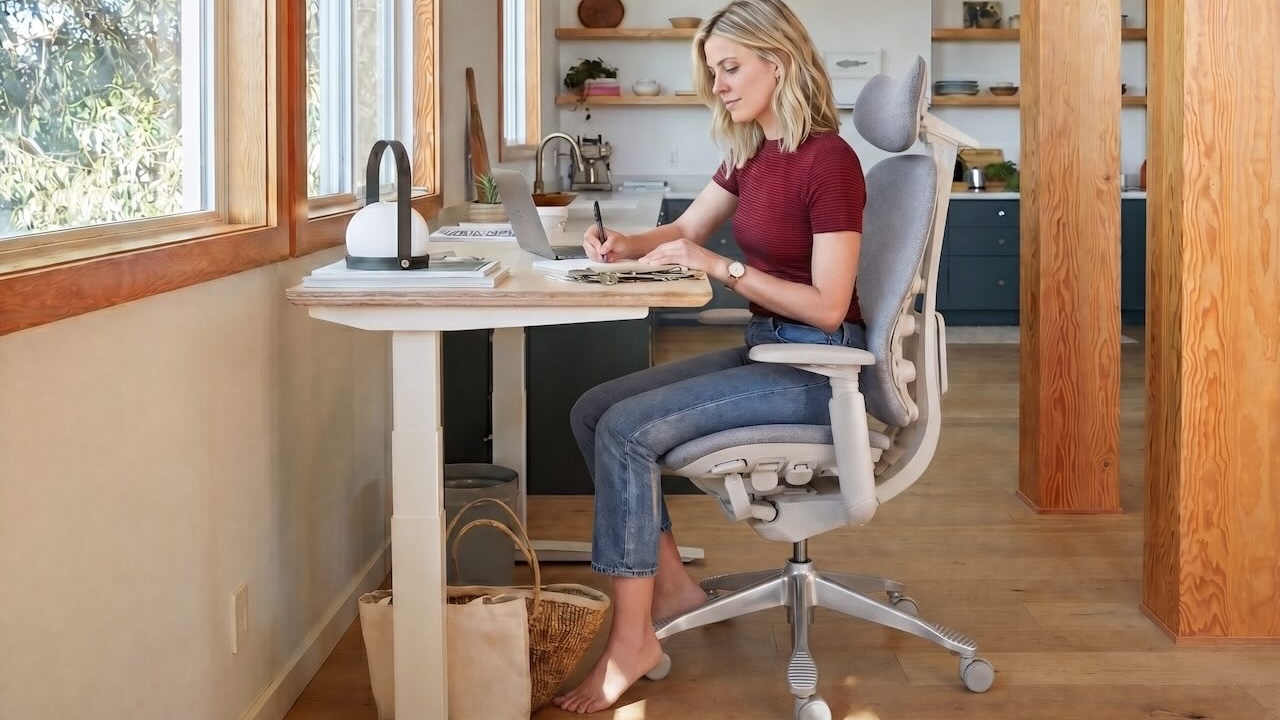
It can. A forward tilt opens your hip angle and moves some weight off the backs of your thighs when you lean in to type or write. It also encourages small, frequent position changes.
An open-MRI study of seated spinal posture found that a forward-inclined sitting position helped preserve the spine's natural curve compared with a plain upright posture, which lines up with older biomechanics research suggesting a slight forward seat tilt reduces strain on the hamstrings and lower back. It's worth saying plainly: not every study agrees on how much forward tilt helps, so treat it as one useful tool for shifting pressure and posture through the day, not a guaranteed fix on its own.
Why do female-specific proportions matter beyond seat size?
Wider hips, a shorter torso, and a lower center of gravity change where lumbar support, the seat pan contour, and the tilt pivot should sit. Small offsets add up to pressure in the wrong places.
How Does the ARBREST COVE Office Chair for Women Solve the Extra-Inch Problem?
COVE combines a 43–49 cm seat-depth range, a multi-density cushion with a softer front edge, 46–54 cm height adjustment, and a 16° forward tilt, all built from female body measurements. Together, these are designed to keep the seat edge away from the back of your knee.
| Problem | COVE feature | What it means for you |
|---|---|---|
| Seat sits too deep for your thighs | 43–49 cm seat-depth range | You can slide the pan back until the front edge clears the back of your knee |
| Firm edge digs into thighs or knees | Multi-density Cloud-Zone cushion | Firm support under the sit bones, softer give at the front edge |
| Feet can't rest flat, pressure builds under thighs | 46–54 cm seat-height range | You can set knees to roughly 90° with feet supported |
| Slouching under a deep seat compounds the pressure | 16° forward-tilt mode | Shifts hips forward and takes load off the backs of the thighs during focused work |
Can COVE's seat depth fit petite and average-height women?
Yes. The 43–49 cm range starts at a depth that matches ergonomic guidance for shorter users, and it covers roughly the 5th through upper-average percentiles of women's thigh length.
That 43 cm minimum lines up with the same approximate figure Cornell's ergonomics research associates with a shorter-than-average woman's buttock-to-knee-crease length, referenced in the comparison table earlier in this article.
What is the Cloud-Zone cushion, and how does it protect the back of your knees?
It's a multi-density cushion: firm under your sit bones for stability and softer toward the front edge, so it gives instead of digging in, even when you sit forward.
How should you set COVE's seat height?
Adjust between 46–54 cm until your feet rest flat and your knees sit at about 90°. If you're on the shorter side, pair it with a footrest.
In the interest of being straightforward: a 46 cm minimum is on the higher end for some shorter and petite women, depending on your leg length and shoe heel height, it won't let every single body sit with feet completely flat with no assistance. If you try COVE and your feet don't fully reach the floor at the lowest setting, a footrest closes that gap completely and is a normal, recommended part of a proper setup rather than a sign the chair doesn't fit you. Use the finger test and the wall-measurement method above to confirm fit for your own body rather than relying on the range alone.
When should you use COVE's 16° forward-tilt mode?
Use it during focused, lean-in work like typing, writing, or detailed screen tasks. It moves your hips forward, takes load off your thighs, and keeps your lower back supported instead of slumped.
How can you tell if COVE actually helps your legs?
Use the 30-day trial as a structured test. Track symptoms for a week in your current chair, then for two weeks in COVE.
Turn the trial into a simple self-experiment with a daily log:
| Day | Numbness/tingling | Ankle swelling (sock-line marks) | Afternoon heaviness |
|---|---|---|---|
| 1 | |||
| 2 | |||
| … | |||
| 14 |
Compare your average scores from your old chair against week one and week two in COVE. A downward trend is the clearest signal that the COVE office chair for women is actually working for your body.
Beyond the Chair: What Daily Habits Improve Leg Circulation at Your Desk?
Even a perfectly fitted chair can't replace movement. Stand or walk for a few minutes every 30–60 minutes, do ankle pumps and calf raises while seated, avoid crossing your legs for long periods, and stay hydrated.
A controlled study on sitting and lower-leg swelling found that simply breaking up sitting time with brief sit-to-stand transitions measurably reduced leg swelling compared with uninterrupted sitting, reinforcing that movement and a well-fitted chair work together, not as substitutes for each other.
What are the best seated exercises for leg circulation?
- Ankle pumps: point and flex your feet, 15–20 reps each hour.
- Ankle circles: 10 rotations each direction, per foot.
- Seated marching: lift knees alternately for 30 seconds.
- Heel–toe raises: 15 reps, engaging the calf muscle pump.
- Knee extensions: straighten one leg out, hold 2–3 seconds, 10 reps per side.
Should you wear compression socks at your desk?
They help some people with swelling, but check with a doctor first, especially if you have circulation problems or diabetes.
Cleveland Clinic's guide to compression socks and Mayo Clinic's guidance on compression stockings both note they can help manage mild swelling, but recommend professional fitting and medical guidance before regular use, particularly for anyone with an existing circulation condition.
Does crossing your legs really affect circulation?
Crossing at the knee adds pressure in the same area a deep seat does. An occasional cross is fine; sitting that way for hours adds up.
FAQ: Office Chair for Women and Leg Circulation
What is the best seat depth for a short woman?
Most short women do best with a seat depth starting around 15.5–17 inches (about 39–43 cm) at its shortest adjustable setting, so the front edge clears the back of the knee while the lower back still reaches the backrest. The exact number depends on your individual thigh length, so use the finger test to confirm.
Why do my legs fall asleep in my office chair?
Legs falling asleep at a desk is usually paresthesia: the seat edge or an awkward position compresses a nerve behind the knee or under the thigh, interrupting its signal. It typically resolves within a minute of shifting position; if it happens constantly or doesn't resolve, your seat depth or height likely needs adjusting.
Can an office chair cause swollen ankles?
An office chair itself doesn't cause swelling, but a seat that presses into the back of your knees, combined with hours of not moving, can make it harder for blood to return from your lower legs, so fluid collects around the ankles. Correcting seat depth and taking movement breaks often reduces this.
What's the difference between a regular and an ergonomic office chair for women?
A regular chair is usually sized to one fixed set of average dimensions, often based on male anthropometric averages. An ergonomic office chair for women adjusts seat depth, height, and sometimes tilt and lumbar position around a shorter torso, shorter thighs, and wider pelvis, so the fit is accurate rather than approximate.
Is a waterfall seat edge worth it?
Yes, for most people. A waterfall or softened front edge spreads pressure across more of the thigh instead of concentrating it in a narrow band behind the knee, which matters most if you sit toward the front of your seat or have shorter thighs relative to the seat pan.
How do I know if my office chair is too big for me?
Signs include less than two finger-widths of space behind your knee when you sit all the way back, a habit of perching on the front edge, feet that dangle or rest on tiptoes, and pressure marks or numbness behind the knees by midday.
Can sitting too long cause blood clots?
Prolonged sitting is a recognized risk factor for deep vein thrombosis because it slows blood flow in the legs, according to the CDC. The risk is highest with several hours of uninterrupted sitting; if you notice one-sided leg swelling, pain, or warmth, see a doctor promptly rather than waiting it out.
Is forward tilt good for your legs?
A forward-tilting seat can open the angle at your hip and shift some weight off the backs of your thighs during lean-in tasks like typing, which may ease pressure behind the knee. Evidence on forward tilt and posture is still mixed, so treat it as one helpful option, not a cure-all.
The Bottom Line on Seat Depth and Circulation
One inch of excess seat depth doesn't sound like much, but spread across an eight-hour workday, it can mean constant pressure on one of your body's most sensitive spots, right where major blood vessels and nerves sit closest to the surface. The 60-second finger test is the single action worth taking today: sit back, slide your fingers behind your knee, and see where you actually stand.
If your current chair fails that test, see how the ARBREST COVE fits your body, backed by a 30-day trial so you can test it at your own desk before committing. Comfort at work isn't a luxury, and your chair should be built to fit your body, not the other way around.
Related reading: How to Set the Right Seat Height for Your Body · A Guide to Lumbar Support · Best Office Chair Options for Petite Women · ARBREST's 30-Day Trial Policy